According to current statistics, more than 1.3 billion people worldwide live with some form of disability. In the Western world, it has long been established that creating an accessible environment in public spaces and commercial buildings is a matter of civil rights, rather than mere goodwill. This means that the ability to use an elevator independently and safely, without the assistance of accompanying personnel, must be available to everyone.
A genuinely reliable and experienced elevator company that approaches its work with high responsibility will always offer a client not just a mechanically sound piece of equipment, but a system that fully aligns with the principles of Universal Design. This concept implies creating an environment that is equally comfortable for individuals with hearing, visual, cognitive, or musculoskeletal impairments.
What Does an “Accessible Elevator” Actually Mean?
A misconception persists in Georgia that a specialized elevator for persons with disabilities only refers to a system tailored for wheelchair users. In reality, compliance standards address a much broader spectrum of public needs. When we discuss accessibility, we are referring to a design framework that simplifies life for all visitors to a building, regardless of their specific physical or cognitive requirements.
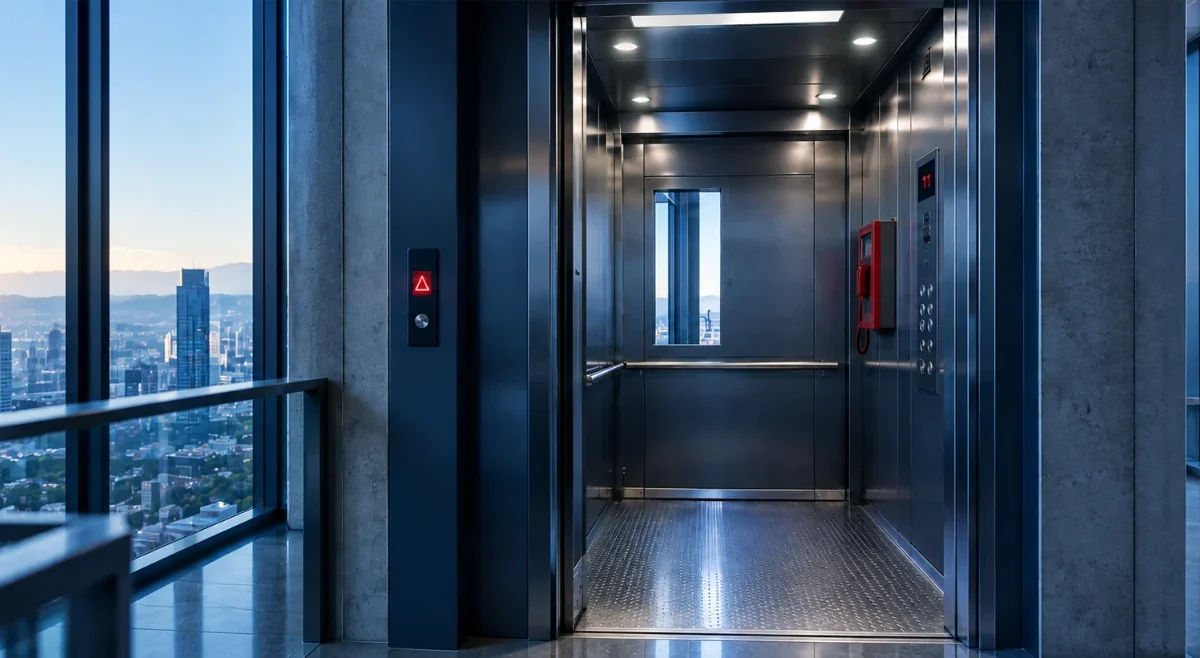
For example, in Europe, a well-designed modern elevator can be utilized independently by an individual with severe visual or hearing impairments. For those with visual impairments, non-visual cues—such as verbal voice announcements and tactile buttons—provide vital orientation. For passengers with hearing loss, dedicated visual indicators and signal displays appear on the screen. Furthermore, the car operating panel is engineered to be highly logical and intuitive, easing transit for individuals with cognitive variations. While each of these specific elements might seem secondary when viewed strictly through the lens of mobility, together they form a cohesive ecosystem that maximizes independence for even the most vulnerable passengers.
What Technical Parameters Must an Accessible Elevator Meet?
Technical specifications for these elevators are rigidly defined by international standards. These details are often unnoticeable to the average passenger but play a decisive role in ensuring safety:
Clear Door Opening Width: The clear entrance width must be at least 90 cm to allow unhindered entry and exit for wheelchair users.
Adjustable Door Dwell Time: The standard 3-second door pause is frequently insufficient for passengers with limited mobility. Therefore, international regulations (ISO 8100-7) mandate that the door open dwell time must be adjustable within a range of an additional 2 to 20 seconds, allowing passengers to enter the cabin without stress.
Advanced Door Protection (Light Curtain): An elevator adapted for persons with disabilities must be equipped with an electronic light curtain—a dense grid of infrared beams. This safety matrix covers the entire height and profile of the door clearance; upon detecting an obstruction, it instantly reverses the doors without requiring physical contact, significantly reducing the risk of a door striking a passenger.
Cabin Dimensions and Mirrors: If the interior floor dimensions of the cabin do not allow a full 360-degree wheelchair turn (requiring a turning circle of at least 150 cm in diameter), installing a mirror on the rear wall becomes mandatory. In this context, the mirror is not a decorative element; it enables a wheelchair user to safely view the space behind them while backing out of the cabin, preventing collisions.
Handrails: Continuous handrails must be installed along the cabin walls to provide vital physical stability and support during transit.
Accessible Control Interfaces: Car operating panel buttons must be positioned at a height of 90–110 cm from the finished floor, making them easily reachable for both standing passengers and seated wheelchair users. It is equally compulsory that all buttons feature raised tactile iconography and Braille lettering for the blind.
Acoustic Announcements: A functional and safe accessible elevator must feature an audible voice synthesizer that clearly announces floor arrivals and the direction of door travel.
Analysis of European Standards: EN 81-70 vs. EN 81-41
European regulations are considered the gold standard in the elevator industry, yet navigating them requires an understanding of specific nuances.
The primary document, EN 81-70, explicitly governs the accessibility of elevators to persons, including persons with disabilities. Despite its widespread adoption, European advocacy organizations (such as ANEC and the European Blind Union) frequently point out areas for improvement. For instance, EN 81-70 only mandates a 30% visual contrast level (Light Reflectance Value – LRV) for button symbols, which experts argue is insufficient for visually impaired passengers; they recommend increasing this contrast threshold to at least 60%. Similarly, the growing use of unadapted touchscreens inside cabins faces criticism—without proper acoustic and tactile feedback systems, touchscreens remain entirely inaccessible to blind users.
There are structural scenarios where an existing building’s architectural layout cannot accommodate a standard, deep-pit passenger elevator hoistway. In these cases, a specialized vertical lifting platform represents an ideal solution. In Europe, these vertical platforms designed for persons with impaired mobility are governed by a separate standard—EN 81-41.
While standard commercial elevators travel at speeds well exceeding 30 meters per minute, EN 81-41 platform lifts operate at a deliberately slow pace (a maximum of 0.15 m/s). Additionally, their control mechanisms frequently rely on a “hold-to-run” constant-pressure button scheme. This serves as a practical architectural compromise when constructing a standard structural shaft is technically unfeasible.
The Dangers of Transporting Passengers with Disabilities via Freight Elevators
Frequently, building owners attempt to cut corners by utilizing existing freight elevators to transport wheelchair users. This approach is fundamentally flawed and introduces severe safety hazards. In accordance with strict technical regulations (such as ASME A17.1 and local codes), a freight elevator is engineered exclusively for the transportation of material goods; the presence of general passengers inside the cabin—other than designated freight handlers—is strictly prohibited.
Freight elevators are frequently equipped with heavy, vertically bi-parting doors that close from the top and bottom simultaneously. These industrial doors generally lack the sensitive light curtains or passenger-grade safety edges found on passenger systems, and their closing impact force vastly exceeds passenger elevator safety thresholds. Consequently, forcing a wheelchair user to operate or travel in a freight elevator drastically increases the risk of severe physical injury.
Furthermore, freight systems present a floor leveling challenge. Unlike passenger models, standard freight lifts allow for a slight vertical variance (mis-leveling) between the building floor slab and the cabin sill during loading. While a minor lip is negligible when moving palleted cargo, it can easily trap or flip a wheelchair caster wheel, leading to sudden tipping.
Conclusion: Partnering for True Accessibility
Achieving a truly inclusive environment where vertical mobility is accessible to everyone demands strict adherence to European regulations (the EN 81 series), selecting the appropriate system class, and integrating modern safety technologies. If you want to ensure your property is adapted to genuine international standards, it is essential to consult with qualified engineering experts who can guide you through the correct technical specifications for your specific facility.