Elevator installation is a critical phase in construction. In multi-story buildings, the elevator is a vital component upon which the safety of thousands of people depends. Unfortunately, when non-professionals handle the installation process, they frequently make errors that subsequently become the root cause of serious accidents. Statistically, the vast majority of elevator incidents are the direct result of improper installation.
It is important to remember that even work performed by professionals is not entirely immune to errors, whether due to technical reasons or human factors. Therefore, being able to identify these shortcomings is essential to facilitate effective prevention later on.
Elevator safety is directly linked to correct installation. For the safe operation of an elevator, it is absolutely essential to utilize the services of an experienced elevator installation team. The technical knowledge and expertise of such a team provide the highest guarantee for preventing the hazardous—and often fatal—consequences caused by these errors.
1. Errors in Technical Documentation
The accuracy and completeness of technical documentation form the baseline of any installation. At this stage, it is relatively easy for an error to go unnoticed, which later manifests as a serious operational issue. Therefore, careful attention must be paid to the following factors:
Incomplete Technical Documentation: Incomplete blueprints mean that technicians lack vital data regarding component parameters (such as materials and specific dimensions), explicit installation requirements, and system interactions.
Discrepancies with Building Infrastructure: During the design phase, the actual physical structure of the building—such as hoistway dimensions, wall conditions, and floor-to-floor heights—is often not fully surveyed. Consequently, the blueprint may prove incompatible during assembly, requiring significant design alterations and additional construction work, which disrupts schedules and increases expenditures.
Inadequate Integration of Safety Codes: Safety requirements are sometimes poorly documented during planning. This includes emergency management logic (such as fire recall operations), integration with building fire safety systems, evacuation protocols, or accessibility adaptations for persons with disabilities (PWD).
To compile high-quality documentation, close collaboration is required among architects, structural engineers, and elevator specialists, backed by thorough field surveys and strict compliance with current regulatory standards.
2. Mechanical Installation Errors
The precise assembly of mechanical components bears a direct impact on the elevator’s operational quality, durability, ride comfort, and safety. At this stage, even a minor misalignment can result in a catastrophic failure.
Improper Hoistway Engineering: This is a fundamental error. Even a millimeter-level deviation in hoistway dimensions or verticality can cause guide rail misalignment. Exact hoistway parameters, along with plumb and structurally sound walls, are critical for secure rail mounting and solid bracket fixation.
Improper Balancing of the Cabin and Counterweight: Achieving an exact balance is vital for efficient elevator performance. Incorrect balancing—where the counterweight does not match the ideal formula of Cabin Weight + 40-50% of the Nominal Rated Load—causes continuous overloading of the drive mechanism, excessive energy consumption, and premature wear on critical mechanical components such as the motor, brakes, and hoist ropes.
Incorrect Guide Rail Installation: The installation of guide rails requires absolute precision. Rails installed with deviations or tilts lead to cabin vibrations, excessive operational noise (such as humming or clicking), and accelerated wear on guide shoes and rollers.
Improper Assembly of Suspension Mechanisms: Inadequate fastening of the hoist ropes securing the cabin and counterweight, improper tensioning, or the use of sub-standard components can lead to catastrophic accidents. It is mandatory to use only certified fasteners recommended by the manufacturer, secure them to predetermined torque parameters, and continuously verify uniform rope tension.
These mechanical tasks demand high qualifications, specialized calibration tools, detailed logging, and constant verification. In most scenarios, involving a specialized elevator company is necessary to bring all these requirements into full compliance with industry standards.
3. Electrical System Failures
Improper installation and configuration of electrical systems create not only operational malfunctions but also severe safety hazards.
Use of Incorrect Cable Gauges or Types: The elevator motor and control panel require specific electrical capacities, which mandates cables with appropriate cross-sectional areas, quality insulation, and ratings. Utilizing cables with an insufficient cross-section or an incompatible type can lead to overheating, insulation breakdown, short circuits, fire hazards, or severe damage to the motor and main controller boards.
Improper Programming and Configuration of the Control System: Modern elevators are managed by sophisticated software. Incorrectly setting parameters (such as speed profiles and acceleration curves) or software configuration faults can cause unstable or uncomfortable cabin movement, inaccurate floor leveling, erratic door operation, or total system failures. Incorrect configuration can also create critical conflicts within the safety logic.
Incorrect Placement or Connection of Safety Sensors: Numerous sensors—including door protection devices, overload sensors, overspeed switches, and terminal limit switches—ensure safe operations. Misplacing them (which leaves dangerous “blind spots”), wiring them incorrectly, or failing to calibrate them properly drastically increases the risk of accidents, as the system may fail to detect an obstacle, an overspeed condition, or other hazardous states.
Incomplete or Faulty Emergency Alarm Installation: Emergency communication systems, such as alarm bells and intercoms, are critical for maintaining contact between trapped passengers and external rescue services. Incomplete installation, low-quality components, improper wiring, or inadequate testing of the emergency backup power supply directly compromises timely passenger rescue during emergencies.
Preventing these electrical issues requires the involvement of qualified professionals, the use of premium-grade components, and a granular verification of every electrical circuit and safety function prior to commissioning.
4. Safety System Failures
Improper installation, faulty adjustment, or insufficient testing of critical safety components poses a direct threat to passenger lives.
Improper Brake System Calibration: If the main drive brake is incorrectly adjusted, the elevator may fail to stop accurately at the floor level (creating tripping hazards) or, in extreme situations, the system may fail to provide timely and reliable stopping power to hold the cabin safely. Precise calibration matching manufacturer standards and repetitive drop-load testing are mandatory.
Inadequate Testing of Emergency Stopping Mechanisms: The safety gears (safeties) and the overspeed governor are the absolute final lines of defense. It is imperative to perform full simulation testing under real-world operational profiles—such as mechanically tripping the governor to activate the safeties—upon completion of the physical installation.
Improper Installation and Calibration of Door Interlocks: Faulty adjustment of the mechanical and electrical door locking mechanisms means an elevator could potentially begin moving while a landing door is still open or unlocked. Furthermore, poorly calibrated door safety edges can fail to detect a passenger, causing them to be struck or pinned by the doors. These systems require exact alignment and repetitive cycle testing before commissioning.
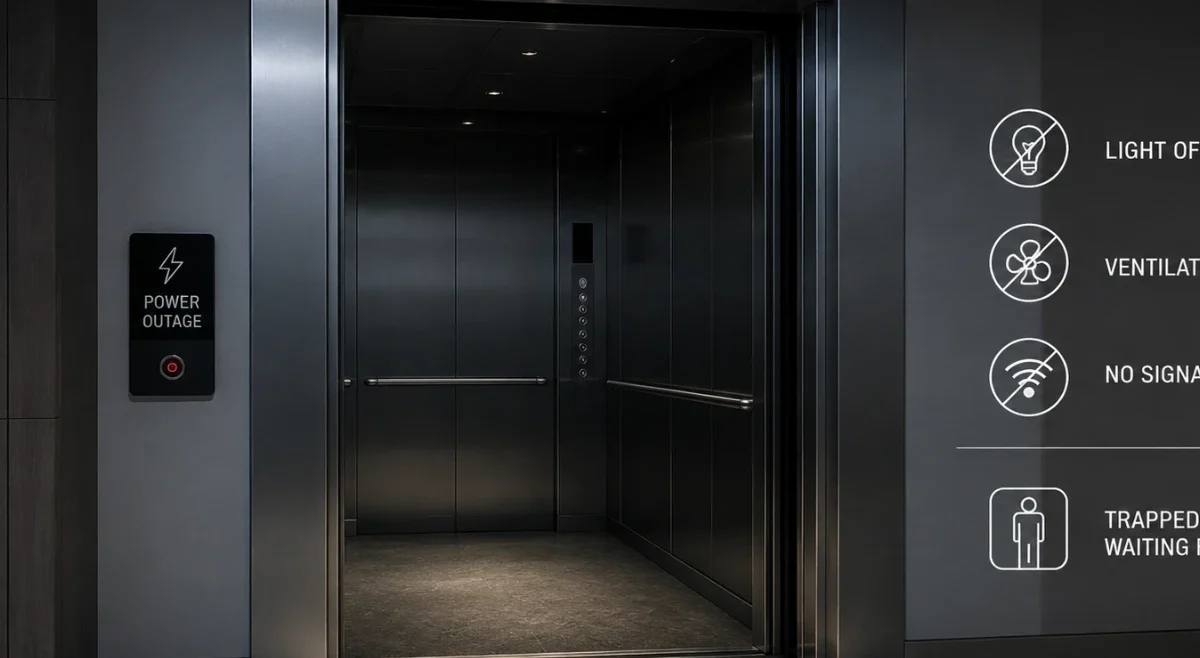
Emergency Lighting and Backup Power Failures: In the event of a primary power outage, a reliable emergency lighting array and an independent alarm power source (battery backup) are critical. Utilizing batteries with insufficient capacities or low build quality, or having a faulty charging circuit, means the cabin could be plunged into total darkness. The backup system must guarantee sufficient illumination for a legally mandated duration (minimum of 1 hour) and must be tested regularly.
As elevator history demonstrates, improper installation can bring tragic consequences. However, with proper planning and a professional approach, these risks can be entirely neutralized. The key lies in unwavering attention to technical detail and strict adherence to professional engineering standards.
Involving certified specialists at every phase of assembly is the true cornerstone of a successful project. Their specialized knowledge and experience ensure not only technically sound assembly but also full compliance with safety codes and the proactive prevention of latent defects.
Additionally, the importance of regular inspection and monitoring must be highlighted long after the initial setup is complete. To guarantee the ongoing integrity of the elevator, continuous technical supervision and periodic statutory elevator inspections are mandatory. Elevator installation is a highly complex process where a professional approach, flawless planning, and systematic monitoring ultimately guarantee successful, long-term, and safe operation.